Paid Advertising
Why Your Digital Marketing Isn't Working (And What to Do About It)
V
By Viraj Perera2026-07-14
5 Min Read
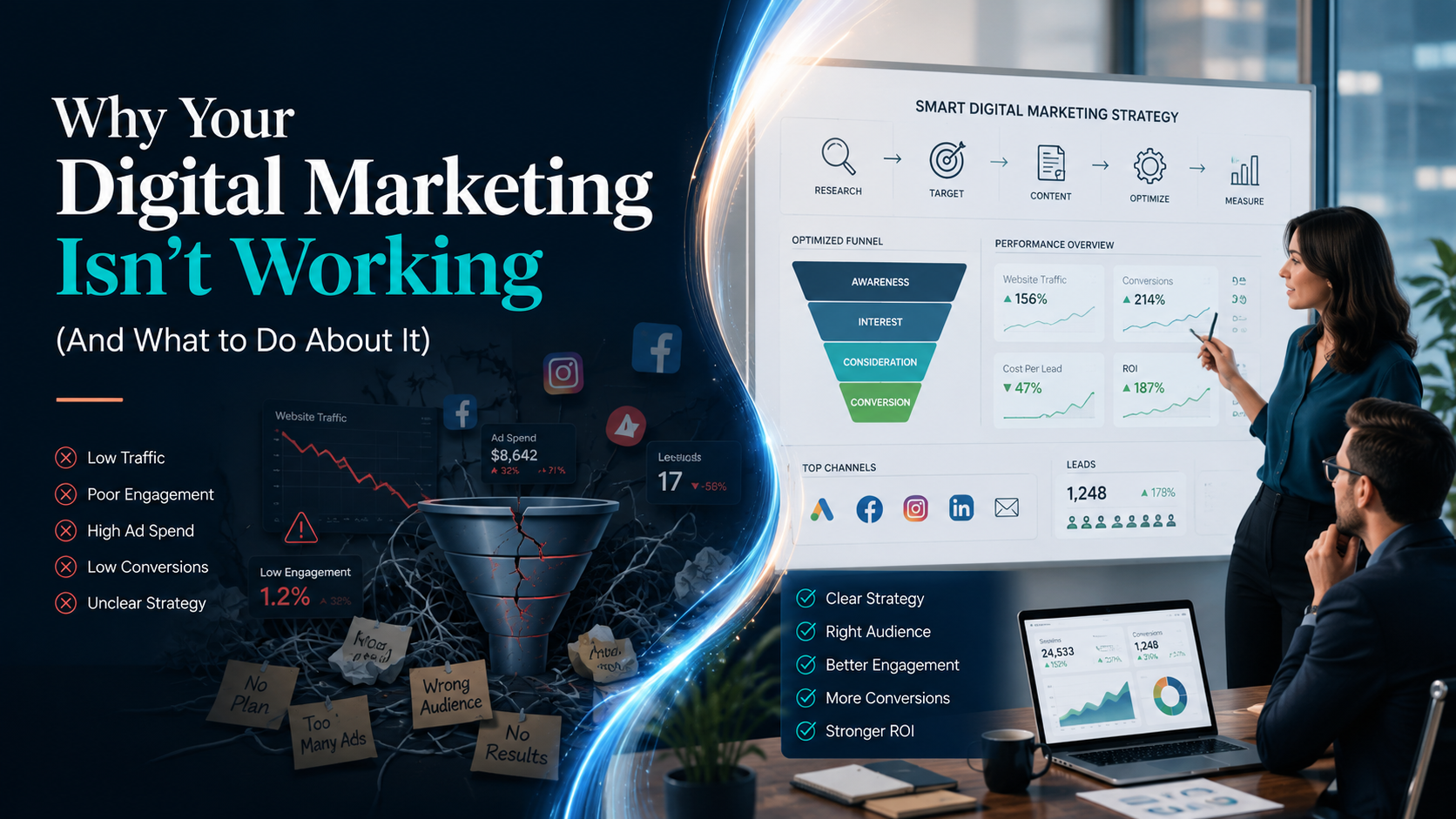
You're running Facebook Ads. You have someone managing your Instagram. Maybe you're even doing Google Ads. But the leads aren't coming in, the sales haven't moved, and you're starting to wonder if digital marketing actually works for businesses like yours.
It works. The problem is almost never the channel. It's almost always one of six fixable things.
Here's how to diagnose which one is killing your results.
1. You're Running Ads Without a Strategy
This is the most common and most expensive mistake in Sri Lanka's digital marketing market.
A strategy isn't a content calendar. It isn't a list of ad objectives. It's a clear answer to three questions: Who exactly are you targeting? What do you want them to do? And why would they do it over every other option in front of them?
Most businesses in Sri Lanka skip this entirely and jump straight to execution. They boost posts, run traffic campaigns, and wonder why nothing converts. The boosted post reaches people. The traffic campaign sends clicks. But without a strategy underneath it, neither one knows who to reach, what to say, or what to offer.
The fix: Before spending another rupee on media, define your target audience with precision (not "women aged 25–45" that's a demographic, not an audience), identify the one action you want them to take, and build every piece of creative and copy around that action.
2. Your Tracking Is Broken
This is the silent killer. You might be generating leads and not know it. Or you might be burning budget on campaigns that have never worked while pausing the ones that actually do, because you can't tell the difference.
Broken tracking is endemic in Sri Lanka's digital marketing space. Common symptoms:
◾Your Meta Ads Manager shows website traffic but zero conversions
◾Your Google Ads has no conversion action set up
◾Your Google Analytics shows sessions but nothing downstream
◾You're measuring leads by counting WhatsApp messages manually
If you can't tell precisely which campaign generated which lead at what cost, you are flying blind. Every optimisation decision you or your agency makes is a guess dressed up as strategy.
The fix: Install Google Tag Manager. Set up Meta Pixel with server-side verification. Configure Google Ads conversion tracking tied to actual lead events, not page visits. Connect everything to GA4. This infrastructure isn't optional, it's the foundation that makes every other decision meaningful.
3. Your Creative Isn't Stopping Anyone
Sri Lankan feeds are crowded.Short-form video dominates social media, with TikTok, Instagram Reels and YouTube Shorts capturing over 60% of under-35 attention. Your audience is scrolling past dozens of ads before they even get to yours.
Most digital marketing creative in Sri Lanka falls into one of two failure modes. The first is generic design, blue background, company logo, a list of services, a phone number. The second is feature-led copy "We offer the best quality at the lowest price" which says nothing because every competitor says the same thing.
Neither stops a scroll. Neither earns attention. Neither builds a case for why someone should choose you.
The fix: Lead with the customer's problem, not your product. Show the outcome they want, not the service you provide. Test video against static. Test human faces against product shots. The creative that wins is almost never the one that feels safest in the boardroom.
4. Your Landing Page Is Losing the Lead
You can have perfect targeting, flawless tracking, and outstanding creative, and still generate zero leads if the page someone lands on doesn't convert.
Most Sri Lankan business websites are built to impress, not convert. They have elegant design, a long homepage, a services section, an about page, and a contact form buried three scrolls down with five required fields and no compelling reason to fill it out.
A person who clicks your ad is not browsing. They're evaluating. They need to arrive at a page that immediately confirms they're in the right place, makes one clear offer, and gives them one simple next action.
The fix: Build dedicated landing pages for each campaign, separate from your main website. One headline. One offer. One CTA. Remove the navigation menu, you don't want them going elsewhere. On mobile, which is where over 70% of Sri Lankan internet users ac
5. Your Follow-Up Is Non-Existent
This one doesn't get talked about enough. Digital marketing gets blamed for bad results when the actual problem is what happens after the lead comes in.
We've seen this pattern repeatedly with Sri Lankan businesses: a campaign generates 40 leads in a month, the client says the campaign didn't work, we dig in and find that 30 of those leads were never contacted at all. The ones that were contacted got a single WhatsApp message and no follow-up when they didn't reply.
A lead is not a sale. A lead is the beginning of a conversation. If your sales process doesn't have a structured follow-up sequence, at minimum, three touches within the first 48 hours, you are wasting most of your ad spend regardless of how well the campaign performs.
The fix: Set a response SLA of under two hours for every inbound lead. Build a three-step follow-up sequence: first contact, value follow-up, final close attempt. Track conversion from lead to appointment to sale. If this number is below 20%, the problem isn't your digital marketing, it's your sales process.
6. You're Measuring the Wrong Things
Your agency sends you a report every month. It shows reach, impressions, follower growth, and engagement rate. Everyone feels good about the numbers. But the business isn't growing.
Reach is not revenue. Impressions are not income. Follower count is a vanity metric dressed up as a KPI. These numbers measure activity, not outcomes, and activity without outcomes is just expensive movement.
The metrics that actually matter are: cost per qualified lead, lead-to-appointment rate, cost per acquisition, and return on ad spend. If your current reporting doesn't show these, you don't have a reporting system, you have a reassurance document.
The fix: Define business-level KPIs before your next campaign launches. Agree with your agency on what success looks like in numbers, not in sentiment. If they push back on outcome-based metrics, that tells you something important about how accountable they're willing to be.
The Common Thread
Look at those six problems again. None of them are about the platform. None of them are about the budget. They're all about strategy, infrastructure, and accountability, the things that get skipped when agencies prioritise quick onboarding over proper setup, and when businesses prioritise low cost over genuine results.
Most businesses across Colombo, Gampaha, and Kandy still underinvest in digital marketing relative to their marketing budgets, but underinvestment in budget is rarely the real issue. Underinvestment in thinking, in the strategy, the tracking, and the conversion infrastructure, is what kills most digital marketing programmes before they ever get a fair chance.
How to Audit Your Own Digital Marketing Right Now
Run through these six questions honestly:
1.Can you state your target audience in one specific sentence, who they are, what problem they have, and why your solution fits?
2.Can you pull up your Meta Ads Manager or Google Ads right now and see the cost per lead for your last campaign?
3.When did someone last test a new creative concept on your account?
4.Do your ads send traffic to a dedicated landing page or your homepage?
5.What happens to a lead within the first two hours of submitting a form?
6.Does your monthly report show cost per acquisition, or just reach and impressions?
If you answered "no" or "I'm not sure" to more than two of those, you've found your problem, and more importantly, you've found where to start fixing it.
What a Strategy-First Approach Looks Like in Practice
At Stratworks Global, we don't launch a single campaign until we've completed a diagnostic across all six areas above. That means auditing your current tracking setup, reviewing your conversion funnel, pressure-testing your creative strategy, and agreeing on the KPIs that actually connect to your business goals.
It takes longer upfront. It costs more than an agency that onboards you in a day and starts boosting posts by the end of the week. And it consistently produces better results, because the infrastructure is right before the first rupee goes to a platform.
If you want to understand specifically what's breaking in your current digital marketing setup, let's have that conversation. No pitch, no rate card. Just an honest look at what's working and what isn't.
Strategy First. Always.
Frequently Asked Questions
How long should I wait before deciding my digital marketing isn't working?
Paid channels like Meta Ads and Google Ads need 60–90 days of consistent, properly tracked activity to produce reliable data. Before that threshold, you're in the learning phase, optimising too early kills campaigns before they have a chance to perform. SEO needs 4–6 months minimum. If you're three months in with no measurable movement on a properly set up paid campaign, that's worth investigating. If you're two weeks in and panicking, that's normal.
Is my budget the reason my digital marketing isn't working?
Sometimes, but less often than people assume. A LKR 30,000/month Meta Ads budget with proper tracking, sharp creative, and a converting landing page will consistently outperform a LKR 150,000/month budget with none of those things in place. Fix the infrastructure first, then scale the budget.
Should I change my agency or fix the current setup?
That depends on whether your agency is willing to fix it. Have an honest conversation about the specific gaps — tracking, creative testing, outcome-based reporting, and see how they respond. An agency that takes accountability and proposes a clear remediation plan is worth keeping. An agency that gets defensive or explains away the gaps with platform excuses is probably not.
My social media engagement is high but leads are low. Why?
Engagement and lead generation are different objectives served by different content types and campaign structures. High engagement typically means your content is entertaining or relatable, which is valuable for brand building, but it doesn't automatically generate leads. For lead generation, you need a specific offer, a specific call to action, and a paid amplification strategy behind it. Organic engagement rarely converts to leads at meaningful volume without paid support.